Proudly serving Mesa, Tempe, Phoenix, Chandler, Gilbert, Queen Creek & surrounding areasCall or Text 24/7: 602-905-5577
Aerial view of a residential neighborhood with terracotta-roof homes and desert landscaping in Mesa, AZ.

Budget-Friendly Water Softener Services in Mesa, AZ

Mesa Water Softeners helps Mesa households and businesses compare cheap water softener options by matching equipment and installation scope to tested hardness and actual water demand. Affordable choices include salt-based and saltless water softener systems, reverse osmosis, whole-house filtration, and commercial water softener installations across the East Valley. An inexpensive quote is useful only when it covers the property's actual water use, plumbing, and treatment goals. Budget-friendly planning can also include water softener repair or carbon filtration when those services solve the measured problem, while the cheapest suitable scope avoids capacity, features, and add-ons the water does not require.

Mesa sits in the Salt River Valley, where groundwater and canal-delivered surface water carry minerals from limestone and caliche formations across the Sonoran Desert. A cheap quote can omit a bypass valve, proper drain-line routing, code-compliant electrical work, or preparation and access work that appears later as a service cost. Water hardness, existing plumbing, permit requirements, and softener technology all affect price, so equivalent scope matters more than the headline number. We walk the property and test the water before giving a project-specific estimate.

Water Softener Price and Installation Comparison

The ranges below cover different water softener scopes. Equipment, labor, a bypass valve, drain routing, electrical work, and preparation can create meaningful differences between options, so compare what is included and which factors move each range.

Published Water Softener Installation Ranges by Scope

Project ScopePublished RangeWhat the Range Covers
Professionally installed whole-house softener$1,200 to $3,800 total installedEquipment and labor; capacity, plumbing access, and preparation affect the project total
Salt-free water softener equipment$800 to $4,000 per systemEquipment range; capacity, design, and home size affect the price
Overall water softener system market$200 to $6,000 per systemSpans common system types; equipment design, location, and capacity affect cost

Affordable Water Softener Options in Mesa, AZ

An affordable water softener begins with water testing and system sizing rather than a generic household average. Custom testing helps avoid unnecessary upgrades, while correct sizing prevents paying for more grain capacity or resin volume than the household needs. Demand-initiated models can reduce salt and water use by regenerating from actual demand instead of a fixed timer, making upfront price and monthly operating cost easier to weigh together.

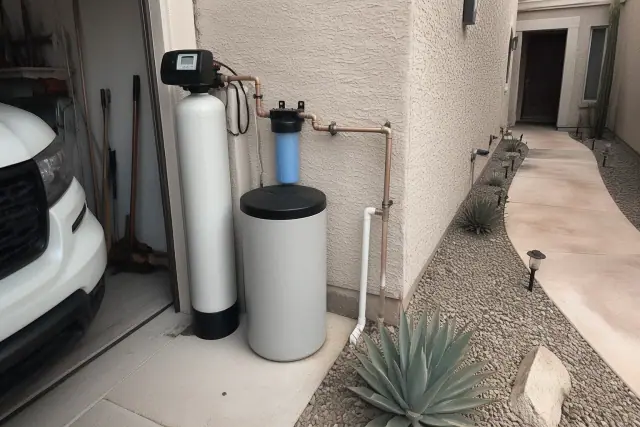
Water softener installation in a residential yard with desert landscaping in Mesa, AZ.

Test Water and Right-Size Softener Capacity

We test for hardness, chlorine, iron, and sediment before discussing equipment. Grain capacity and resin volume scale with the hardness reading and daily water use, so an accurate field or lab test helps avoid oversizing and reduces the risk that an undersized system falls short within a few years.

  • Match grain capacity to the measured hardness level
  • Size resin volume for actual household water use
  • Avoid add-ons that do not address the test results
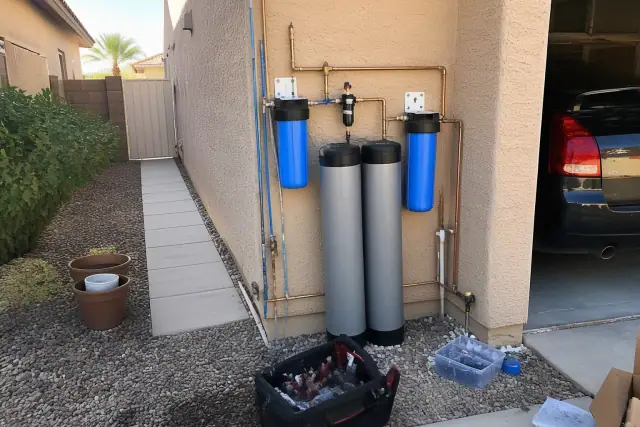
Water filtration system installation in progress at a home in Mesa, AZ, showing exposed tubing and brass fittings.

Compare Water Treatment Options

The cheapest unit on the shelf is not automatically the most useful scope. Salt-based ion exchange treats hardness, saltless conditioning uses different media, reverse osmosis targets drinking water, and whole-house or carbon filtration can address chlorine and sediment. Compare each option by the problem it solves, then include only the treatment the property needs.

  • Salt-based or saltless treatment matched to hardness needs
  • Reverse osmosis added at the kitchen tap when drinking-water treatment is a priority
  • Whole-house or carbon filtration added for chlorine and sediment concerns
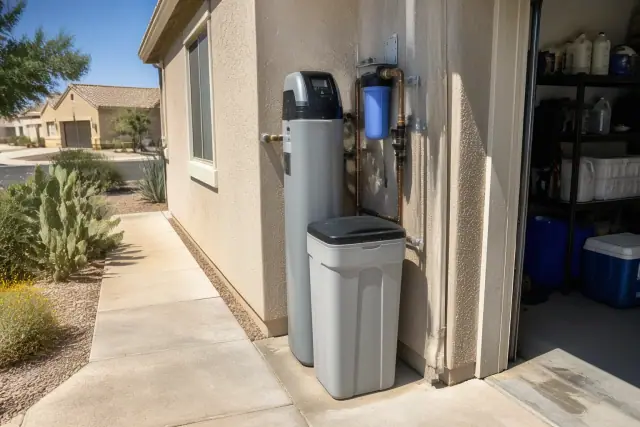
Water softener system installation in a garage water filtration zone at a house in Mesa, AZ.

Balance Upfront Price and Long-Term Value

The lowest prices are hard to compare when one scope omits essential installation work or uses materials that may not hold up under Arizona's mineral load and heat. A low cost plan should still account for demand-initiated controls, durable fittings, a proper bypass valve, and recurring salt, filter, resin, repair, and maintenance needs. Comparing complete scope helps separate a budget purchase from a system that costs more to operate or revisit.

  • Compare demand-initiated regeneration with fixed-timer operation
  • Review brass fittings, NSF/ANSI-rated resin tanks, and bypass-valve quality
  • Check manufacturer warranty terms and ongoing maintenance support

Mesa Water Softener Cost Factors

Water softener cost changes with hardness, household water use, grain capacity, resin volume, control-valve technology, and the difference between salt-based, saltless, or reverse-osmosis equipment. Existing copper, PEX, or galvanized plumbing, single-line versus looped configuration, main-line access, drain routing, electrical connections, permits, and City of Mesa code requirements also shape the scope. Testing the water and walking the plumbing before quoting produces a property-specific estimate instead of a generic figure.

Household Water Demand and Capacity Requirements

A four-bathroom home with a pool and irrigation system uses water differently from a two-bedroom condo. That daily gallon count, together with the hardness reading, determines the capacity tier that makes sense. Correct sizing prevents a household from paying for unused equipment while helping the system regenerate at an appropriate interval.

Plumbing Materials and Equipment Durability

Copper, PEX, and older galvanized lines require different fittings and preparation. Brass fittings, NSF/ANSI-rated resin tanks, and a proper bypass valve cost more upfront than plastic push-fit alternatives but hold up longer under Arizona's mineral load and heat. Control-valve technology affects operating cost too: demand-initiated units regenerate from actual water use instead of a fixed timer.

Access, Preparation, and Installation Timing

A garage installation near an existing hose bib is typically faster and lower cost than work that needs a new drain run or a dedicated outlet for a metered control valve. Most residential softener installations are completed in a single visit, but preparation, bypass placement, and air-gap requirements can change labor and inspection scheduling. Plumbing work must also account for the City of Mesa's adoption of the Uniform Plumbing Code.

Neighborhood Plumbing and Seasonal Demand

Older Mesa neighborhoods such as Dobson Ranch or areas near Downtown Mesa can have plumbing configurations that differ from new construction in Eastmark. Those differences affect access, labor time, materials, and how the bypass and drain are run. Peak spring and early summer demand, as households increase water use ahead of triple-digit heat, can also create longer lead times than a fall or winter installation.

Budget-Friendly Water Softener Planning

Budget planning starts with low-cost water testing for hardness, chlorine, iron, and sediment, then narrows the purchase to a properly sized softener. If several water-quality goals need attention, the work can be phased by starting with the softener and adding reverse osmosis at the kitchen tap or whole-house carbon filtration later. The systems can be integrated without replacing equipment that is already installed.

For budget friendly water treatment, include recurring costs as well as the installation price. Published guidance places annual maintenance for a metered system at around $100 a year, with resin, filters, and salt among the recurring needs regardless of brand. A complete estimate should also identify labor, permit costs when applicable, drain and bypass work, startup service, equipment model, and grain capacity.

  1. Test the water before choosing equipment
  2. Size the softener from hardness and household water use
  3. Phase reverse osmosis or whole-house carbon filtration when priorities allow
  4. Compare purchase price, recurring media, installation scope, and manufacturer warranty terms

Request an Affordable Water Softener Estimate in Mesa, AZ

Request a project-specific water softener estimate for a home or business in Mesa, Gilbert, Chandler, Tempe, Apache Junction, or the greater East Valley. Mesa Water Softeners will test the water, walk the plumbing, explain the recommended equipment and installation scope, and show what the estimate includes before work begins.